Vantage Launches Support for Modal Costs
Track serverless compute costs by app, environment, and GPU type alongside your broader cloud and AI infrastructure.

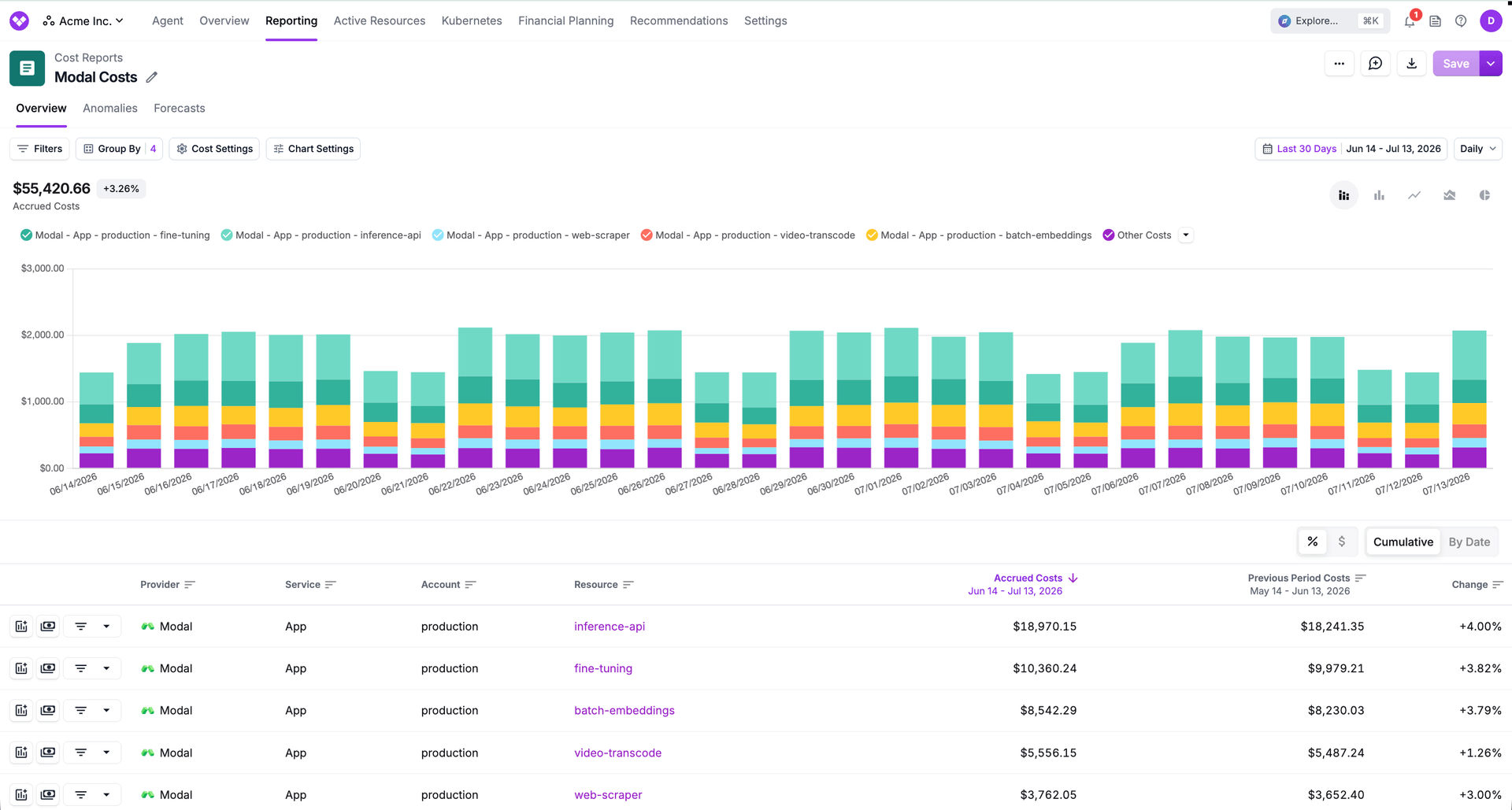
Today, Vantage announces support for Modal cost and usage data, giving customers the ability to track serverless AI and ML compute consumption and costs directly in Vantage. Once connected, Vantage automatically ingests Modal usage and cost data, allowing customers to monitor compute spend by app, function, and GPU type, set budgets, detect spend anomalies, and allocate Modal costs alongside their broader cloud and AI infrastructure.
Modal is a serverless cloud platform teams use to run and scale AI/ML workloads without managing underlying infrastructure. Enterprises adopt it to power GPU-heavy batch jobs, model training, and internal apps, making Modal spend an increasingly meaningful part of their overall infrastructure stack. Previously, Vantage customers relied on manual exports from Modal in order to bring costs into Vantage via Custom Providers.
Now, with Modal cost support in Vantage, customers grant Vantage read access via a Modal API token, and Vantage will automatically ingest their costs to display alongside their other infrastructure costs. Vantage retrieves detailed usage and cost data, including compute costs broken down by app, function, environment, and compute type (CPU and GPU, including specific GPU classes such as A10G, A100, and H100). Customers can view Modal spend alongside their cloud and AI provider costs in Cost Reports, apply Virtual Tags to allocate compute costs by team or product, and configure Budgets and Anomaly Detection on Modal spend.
The Modal integration is now available to all Vantage customers. To connect, go to the Integrations page in account settings and select Modal. You can learn more via the Modal section in Vantage's documentation.
Frequently Asked Questions
1. What is being launched today?
Vantage is launching native support for Modal cost and usage data. Customers can now connect Modal via an API token, enabling automatic ingestion and visibility of serverless compute costs in Vantage.
2. Who has access to this integration?
The Modal integration is available to all Vantage customers across all subscription tiers.
3. How much does this integration cost?
There is no additional fee for using the integration. However, Modal costs will be included in quota tier enforcement. If your Modal costs push you over your current tier limit, you may be prompted to upgrade. See the Pricing page for details.
4. How does the integration work?
Vantage connects to your Modal workspace using a token ID and token secret and pulls daily usage charges via Modal’s billing report. After providing your tokens, Vantage begins ingesting data broken down by app, function, compute type, and GPU class.
5. What permissions are required on the Modal side?
You need to be a workspace Owner or Manager in order to create an API token with access to Modal billing data.
6. What permissions are needed within Vantage?
You must have a Vantage Owner or Integration Owner role to add or remove the Modal integration.
7. What permissions does Vantage have in my Modal account?
Modal does not have any scoping of API tokens. Tokens created by workspace Owners or Managers include additional permissions beyond what Vantage uses; however, Vantage only reads data from Modal’s billing report related to usage and cost, and will never perform any other actions.
Unfortunately, Modal does not currently support fine-grained permissions for API tokens. We recommend customers submit a feature request to Modal for improved permission scoping, and Vantage will adopt fine-grained permissions if this becomes available.
8. What dimensions can Modal costs be filtered and grouped by?
Modal reports support filtering and grouping on the following dimensions:
- Billing Account (description provided when connecting the integration)
- Account (environment, e.g. Staging)
- Service (e.g. App, Function)
- Category (Compute Type, e.g. CPU, Memory, or a GPU type, like H100, B200, etc.)
- Resource (the Modal object ID, such as an App ID)
- Charge Type (e.g. Usage)
- Resource Name (available as tag
modal:description) - Tags (both tags created in Modal and Virtual Tags created in Vantage)
9. Are there Active Resources for Modal?
Yes, Active Resources are available for Apps in Modal.
10. How often does Modal data refresh in the Vantage console?
Modal data refreshes daily in the Vantage console.
11. What happens if I remove the Modal integration?
If you remove your Modal integration from Vantage, all associated costs will be removed from the Vantage console.
12. How far back will the data go?
Vantage imports up to six months of historical Modal cost data upon initial connection. Ongoing retention follows your Vantage data retention settings.
13. Can I have multiple Modal account integrations?
Yes. You can connect multiple Modal workspaces as separate integrations in Vantage.
Sign up for a free trial.
Get started with tracking your cloud costs.