Vantage Launches Native Snowflake Imports for Business Metrics
Write a SQL query against Snowflake and ingest the results as Business Metrics for Unit Costs and Virtual Tag allocation.


Today, Vantage is adding Snowflake as a native import source for Business Metrics. Customers with a Snowflake integration can now write a SQL query defining their Business Metric, and Vantage will ingest the results on a recurring schedule, making the metric available for Unit Costs on Cost Reports and Business Metric Allocation in Virtual Tags.
Vantage already supports native Business Metric ingestion from Amazon CloudWatch, Datadog, and Metronome, in addition to CSV and API uploads for non-native metric ingestion. Customers whose operational metrics (e.g., daily active users, transactions, orders, request volumes, query counts) live in Snowflake have had two options: export to CSV and re-upload manually, or build a custom pipeline against the /business_metrics API. Both options introduce lag, add engineering overhead, and make it harder to keep Unit Cost and Business Metric Allocation calculations current as the underlying data changes.
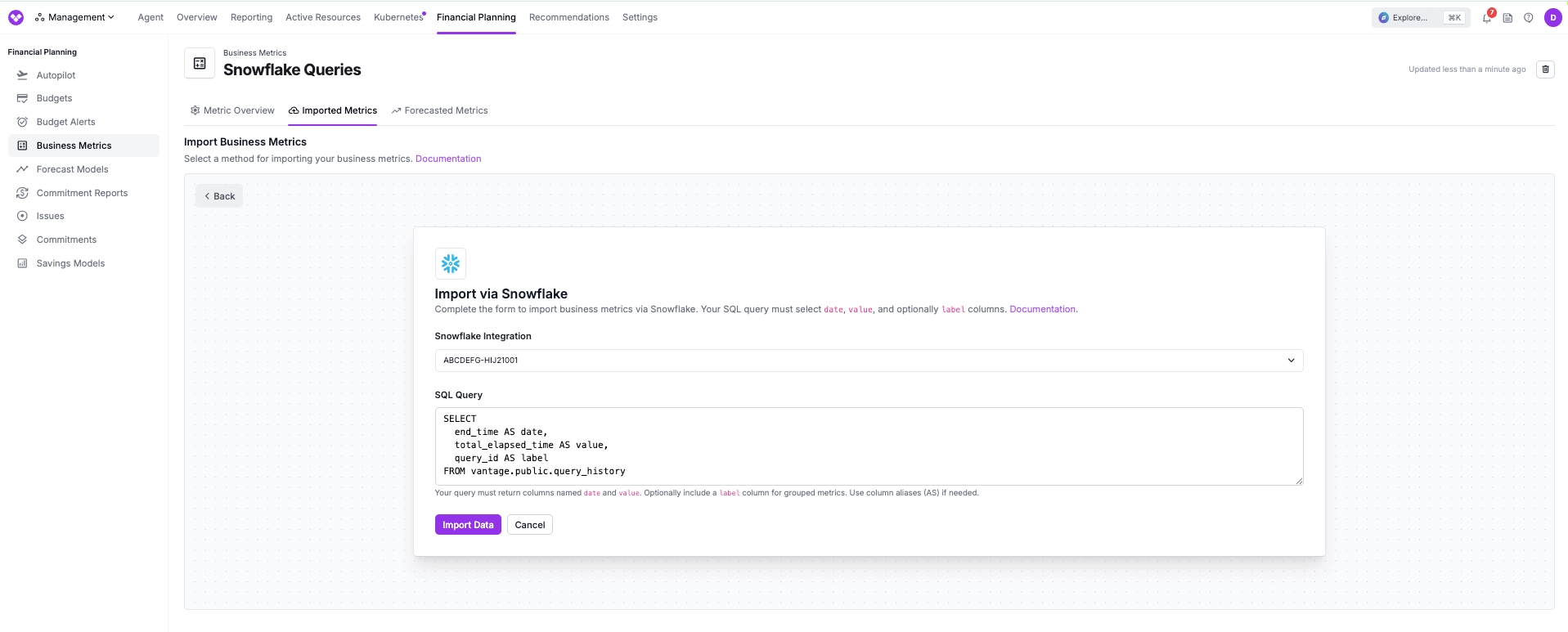
Now, with native Snowflake Business Metric imports, customers select a connected Snowflake integration, paste a SQL query, and Vantage will automatically ingest the metrics. The query must return a date column and a value column, with an optional label column for grouped metrics. Vantage automatically ingests data from the customer's Snowflake warehouse and writes the result rows to the Imported Metrics tab on the Business Metric. Once imported, the metric can be assigned to any Cost Report for per-unit cost analysis or used as the basis for Business Metric Allocation when defining a Virtual Tag. Labels returned by the query carry through to Vantage's existing label-filtering behavior, so per-team or per-application splits work without additional configuration.
The Snowflake Business Metric import is available to all Vantage customers with a connected Snowflake integration. To get started, navigate to the Business Metrics page in Financial Planning, create a new Business Metric, and select Import via Snowflake. See the Per Unit Costs documentation for additional details.
Frequently Asked Questions
1. What is being launched today?
Snowflake is now a native import source for Business Metrics in Vantage. Customers can write a SQL query against their Snowflake warehouse and have the result set ingested as a Business Metric on a recurring schedule. The imported metric is available for Unit Costs on Cost Reports and for Business Metric Allocation when defining a Virtual Tag.
2. Who is the customer?
FinOps, platform, and data teams that already use Snowflake as the warehouse for the business metrics they want to correlate with cloud spend—DAUs, transactions, orders, request counts, ingest volumes, internal query workloads, etc. This is particularly useful for customers who already maintain dbt models or analytics views in Snowflake that produce the metric they care about.
3. How much does this cost?
There is no additional cost for using Native Snowflake Imports for Business Metrics. However, Snowflake must be a connected provider in order to import metrics, and Snowflake costs will be included in quota tier enforcement. In the event that your Snowflake costs push you over your current tier limit, you may be prompted to upgrade. For more details on pricing, see the Pricing page.
4. How do I use it?
From the Business Metrics page on the Financial Planning tab, select New Business Metric. On the Imported Metrics tab, click Import via Snowflake. Then, select your connected Snowflake integration, paste your SQL query, and click Import Data.
5. What does my SQL query need to return?
The result set must include a column named date and a column named value. An optional column named label can be returned to enable grouped metrics. Column aliases (AS) can be used to project arbitrary source columns into the required names. Example:
6. What can I use the imported metric for?
Anything an existing Business Metric supports: assign it to a Cost Report to compute Unit Costs (e.g., cost per DAU, cost per transaction), or use it as the basis for Business Metric Allocation when defining a Virtual Tag to split shared costs proportionally across teams or applications.
7. Do I need an existing Snowflake cost integration to use this?
You need a connected Snowflake integration. The same connection that powers Snowflake cost ingestion can be reused for Business Metric imports, provided the configured role has SELECT access to the tables referenced in the query.
8. What Snowflake permissions does Vantage require?
The configured Snowflake role needs read access to the tables or views referenced in the query, via the vantage user created during Snowflake integration setup. USAGE grants that allow read access to any databases and schemas that will be used for business metrics are required. Vantage does not require write access. Best practice is to use a dedicated role scoped to the smallest viable surface and point the integration at a dedicated XS warehouse to keep credit consumption predictable.
9. How often is the query re-run?
Vantage executes the query daily, aligned with the cost data refresh cadence for other integrations.
10. Can I use labels from my SQL query?
Yes. If the query returns a label column, those values flow into Vantage's label system. When the metric is assigned to a Cost Report or used in Business Metric Allocation, you can filter by specific label values to produce per-team, per-application, or per-customer breakdowns—identical to labels imported via CSV or Datadog.
11. What happens if my query fails or returns no rows?
When you select Import Data after entering a query, Vantage validates that the query returns data by running it with a LIMIT 1. If no data is returned, an error is displayed. For subsequent scheduled syncs, any failed sync is surfaced as an error status on the Business Metric itself.
12. Can I preview my query results before saving?
No, but you will be able to validate imported data on the Imported Metrics tab.
13. Can I use Snowflake imports for Forecasted Metrics?
No, Forecasted Metrics for Dynamic Forecasting must be uploaded via CSV or the Vantage API.
14. Is this available via the Vantage API?
Yes. Snowflake Business Metrics can be created and updated via the /business_metrics endpoint using a snowflake_metric_fields object with a sql_query field, via both POST /business_metrics and PUT /business_metrics/{business_metric_token}.
Example request:
15. Is this available via the Vantage Terraform Provider?
Not at launch. Creating Snowflake Business Metrics via Terraform will be available soon.
Sign up for a free trial.
Get started with tracking your cloud costs.